
One of the hardest things about parental alienation is making sense of someone who appears willing to harm their own child in order to hurt you. It defies logic. It defies every assumption you had about the person you once shared a life with. And yet here you are.
The research on alienating parents is clear about one thing: there is no single profile. Some are driven by narcissistic personality traits. Some are consumed by unresolved anger. Some genuinely believe they are protecting the child. And some — this is the part that is hardest to accept — are barely aware of what they are doing.
None of this makes it acceptable. Understanding the mechanism does not diminish the damage. But it does give you something invaluable: the ability to explain what is happening to a judge, a therapist, or a family member in terms that go beyond "they're doing it on purpose" — and that carry weight in the rooms where decisions are made.
The Machine of Erasure
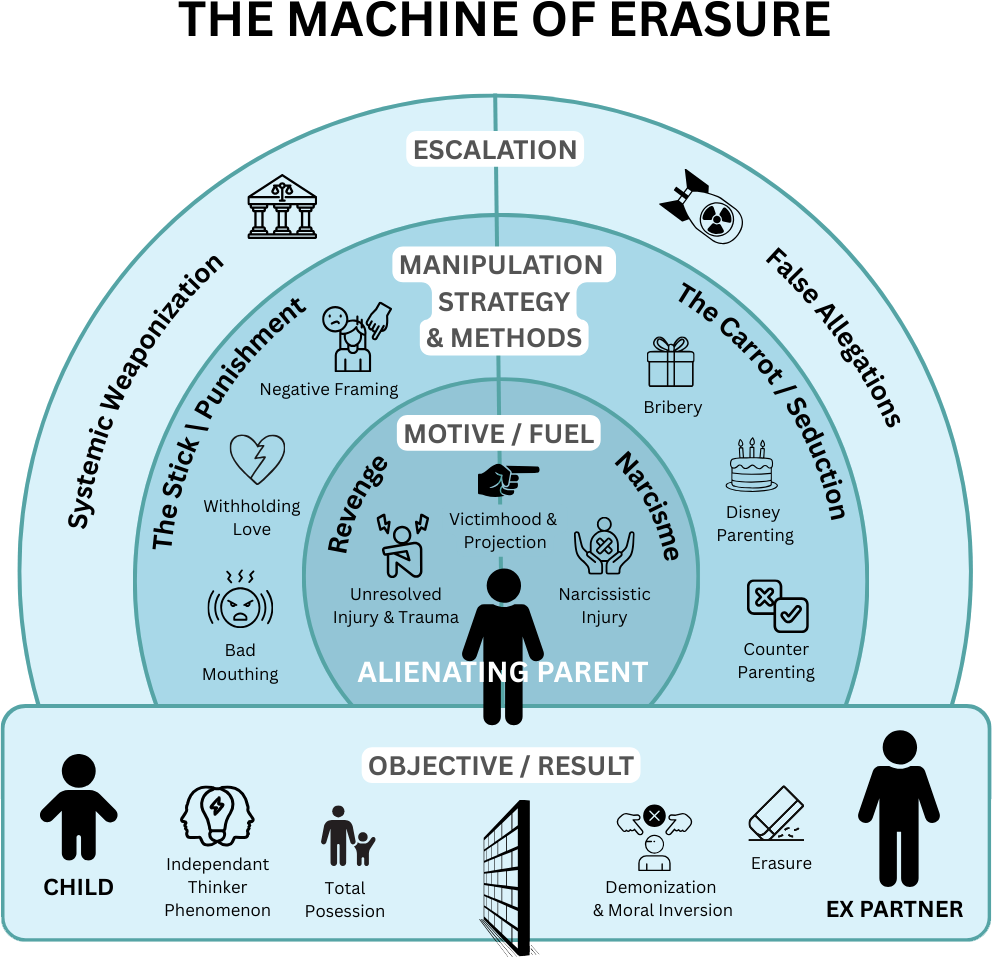
Alienation is not a single behaviour. It is a system — a machine with moving parts, each reinforcing the others. The Machine of Erasure model maps this system from the inside out: from the psychological motives that fuel it, through the manipulation methods that execute it, to the escalation patterns that protect it from intervention.
Understanding this model gives you something no amount of emotional processing can: a structural map of what you are dealing with. When you can see the machine, you can begin to describe it — and when you can describe it, professionals can begin to act on it.
The Core — Motive and Fuel
At the centre of every alienation campaign is a motive. The research identifies three primary drivers: revenge — turning the child into a weapon to punish you for the relationship ending; narcissistic injury — destroying the mirror that no longer flatters; and hostile attachment — maintaining a connection through conflict because hate feels safer than loss. These motives are the fuel. Without them, the machine does not run.
The Inner Gears — Manipulation Methods
The motives drive two complementary strategies. The Stick uses punishment and reality distortion: badmouthing, gaslighting, selective attention, context stripping, and the no-correct-response trap. The Carrot uses seduction: bribery, counter-parenting, the "Disney parent" lifestyle, and the golden handcuffs that make leaving the alienator's world feel impossible. Baker's 17 documented strategies map across both.
The Outer Shield — Escalation
When personal manipulation is not enough, the alienator escalates — outsourcing the abuse to systems and networks. The enabler network provides validation and a Greek Chorus that makes the lie feel like truth. Institutional weaponisation turns the legal system, therapy, and child protective services into unwitting participants. And when all else fails, the nuclear option — false allegations — triggers a systemic freeze that does the alienator's work for them.
The Result — Erasure
The machine's objective is total erasure. The child becomes the "independent thinker" — rejecting you with conviction, parroting the alienator's narrative as their own, displaying none of the ambivalence that characterises genuine estrangement. The targeted parent is demonised. The alienator achieves total possession. And the child — the real victim — loses a parent they once loved, without understanding why.
Exploring the machine
Each layer of the Machine of Erasure is explored in depth across nine pages. Follow the model from the inside out — or start with whatever resonates most with your situation.
The Core — Why They Do It
The Psychology Behind Alienation
What drives them
Narcissism, enmeshment, revenge, fear of losing control — and the alienator's own childhood wounds. The three motives that fuel every campaign, and the intergenerational patterns that explain how someone can harm their own child.
Read more →Conscious vs Unconscious Alienation
The spectrum of intent
Not all alienation is deliberate. Darnell's four types — from naïve to obsessed — and why the distinction changes everything about intervention strategy, legal approach, and how you describe it to professionals.
Read more →The Inner Gears — How They Do It
Baker's 17 Strategies
The documented tactics
Dr Amy Baker identified 17 specific strategies in four mechanisms: the Poisoned Narrative, the Iron Curtain, the Loyalty Trap, and the Erasure. Recognising the pattern in your situation is evidence.
Read more →Gaslighting and Reality Distortion
The stick — punishment and manipulation
Warshak's continuum from badmouthing to brainwashing. The "fast flip," language as psychological surgery, selective attention, context stripping, and the no-correct-response trap.
Read more →The Golden Handcuffs
The carrot — seduction and bribery
Not all alienation operates through punishment. The "Disney parent" trap, material bribery, the electronic leash, counter-parenting, and why it is not love — it is grooming.
Read more →The Outer Shield — How They Escalate
The Enablers
The tribal network
Alienation is rarely a solo act. Flying monkeys, the whisper campaign, the "Greek Chorus Effect," bystander complicity, and how the alienator recruits an entire community.
Read more →Weaponising Institutions
Outsourcing the abuse
How the legal system, therapy, and child protective services are turned into unwitting participants. When the institutions designed to protect your child become the instruments of erasure.
Read more →The Nuclear Option
False allegations as the ultimate weapon
When ordinary weapons stop working. Why false allegations are so devastatingly effective, the three paths to a false accusation, the science of false memory, what the data shows, and surviving the silver bullet.
Read more →The Framework — What It Really Is
"What struck me most about the research was how ordinary it all looked from the outside. Each tactic, taken alone, could be explained away. It is the pattern — relentless, cumulative, deliberate or not — that constitutes the abuse."
Where to go from here
Understanding the alienating parent is only one piece. You also need to understand what is happening to your child — and what is happening to you.